


Break your script into smaller, reusable functions or modules. This keeps your code organized and makes it easier to test, update, or reuse across projects. Create separate files for utility functions. Use parameters instead of hardcoding values. Keep one function focused on a single task.
Background and Context
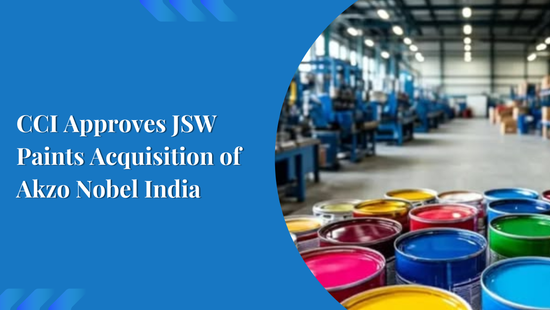
On 30.01.2020, the Competition Commission of India approved the acquisition of Akzo Nobel India Limited by JSW Paints Private Limited. The transaction was notified under Section 6(2) of the Competition Act, 2002. CCI examined the deal under Section 31 and granted approval vide order dated 30.01.2020. This was an important combination in the Indian paints industry. JSW Paints is part of the JSW Group. The group is present in steel, cement, energy and infrastructure. JSW Paints entered the paint business recently and was looking to expand quickly. Akzo Nobel India is a subsidiary of Akzo Nobel N.V., Netherlands. Akzo Nobel sells paints under well-known brands like Dulux, Sikkens and International.
In India, Akzo Nobel had presence in decorative paints, industrial coatings and powder coatings. The transaction involved JSW Paints acquiring 74.76% shareholding in Akzo Nobel India from Akzo Nobel N.V. and its affiliates. The deal also included certain assets and employees. The purpose was to strengthen JSW Paints’ position in the decorative paints market and to enter new product segments. CCI had to examine if this combination would cause an appreciable adverse effect on competition under Section 20(4). The relevant product market was identified as the market for manufacture and sale of paints in India. Within this, CCI looked at sub-segments like decorative paints, industrial paints and powder coatings. The relevant geographic market was India.
Practically what we have seen is that the Indian paint market is dominated by Asian Paints, Berger Paints and Kansai Nerolac. JSW and Akzo Nobel together had smaller market share. CCI noted that post-combination, the entity would still face competition from large incumbents. Entry barriers exist but are not insurmountable. Brands, distribution and technology are important, but new players can enter with investment. CCI analyzed horizontal overlaps. Both JSW and Akzo were present in decorative and industrial paints. However, their combined market share was not high enough to raise concerns. There were sufficient competitors in the market. Buyers like dealers and large customers also had bargaining power. The Commission did not find any vertical issues. The parties did not have control over raw materials or distribution that could foreclose competitors.
Another point CCI considered was efficiencies. The parties submitted that the combination would bring synergies. JSW’s strong balance sheet and distribution network combined with Akzo’s brand and technology would benefit consumers. CCI noted that such efficiencies are relevant but not decisive. The key test was whether competition would be harmed. In our experience, CCI is pro-approval for combinations that do not create dominance. Here, the market remained fragmented even after the deal. The approval was subject to standard conditions. The parties had to ensure compliance with reporting obligations. For the paint industry, this approval signaled that consolidation is possible if it does not harm competition. For JSW, it was a big step to become a national player quickly. For Akzo, it was an exit from a market where it faced tough competition. For consumers, the impact is expected to be neutral to positive.
The order is also important because it shows CCI’s approach to market definition in paints. The Commission looked at both product and geographic dimensions carefully. It did not accept a narrow market definition that would have shown high concentration.
Conclusion
The CCI approval dated 30.01.2020 of JSW Paints’ acquisition of Akzo Nobel India is a significant development in the paint sector. As the law stands, the Commission will approve combinations that do not create dominance or reduce competition. In this case, post-deal market structure remained competitive. Practically, this deal helps JSW scale up fast and gives Akzo an exit. For competition law, it reinforces that market share alone is not enough. Effect on competition is what matters.


