


Introduction
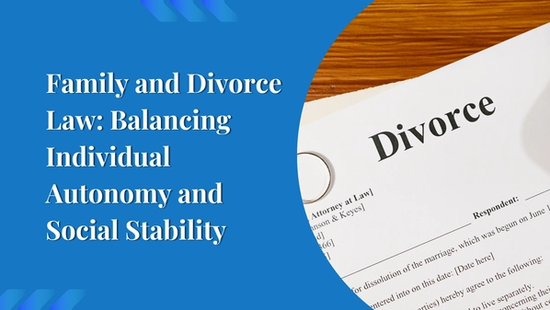
The institution of family has historically occupied a central position within Indian society, functioning not merely as a social unit but also as a legal and cultural foundation governing personal relationships and social obligations. Marriage, in particular, has traditionally been regarded as a sacramental and enduring bond shaped by personal laws and societal expectations.
However, with changing social realities and evolving constitutional values, family law jurisprudence in India has undergone significant transformation. Increasing emphasis has been placed upon individual dignity, personal liberty, and the right of individuals to exit oppressive or irretrievably broken marital relationships. Consequently, divorce law has emerged as one of the most dynamic and contested areas within personal law jurisprudence.
The Legal Framework: Marriage and Dissolution
The Legal Framework: Marriage and Dissolution
Family and divorce laws in India continue to be governed by a combination of personal laws and statutory enactments such as the Hindu Marriage Act, 1955, the Special Marriage Act, 1954, and various principles of Muslim personal law.
Traditionally, divorce was treated as an exceptional remedy available only upon proving matrimonial offences such as cruelty, adultery, or desertion. Courts initially adopted a conservative approach emphasizing preservation of marriage wherever possible. However, judicial interpretation has progressively expanded the understanding of matrimonial cruelty, emotional abuse, and irretrievable breakdown of marriage.
Judicial Evolution: Expanding the Meaning of Matrimonial Justice
A significant shift in divorce jurisprudence emerged in Naveen Kohli v. Neelu Kohli(2006), where the Supreme Court recommended recognizing irretrievable breakdown of marriage as an independent statutory ground for divorce, observing that compelling parties to remain in a dead marriage results in injustice.
Similarly, in Samar Ghosh v. Jaya Ghosh (2007), the Supreme Court substantially broadened the concept of mental cruelty by recognizing emotional neglect, humiliation, indifference, and sustained emotional distress as valid grounds for dissolution of marriage.
The jurisprudence further evolved in K. Srinivas Rao v. D.A. Deepa (2013), where the Court held that false allegations and prolonged matrimonial litigation itself may amount to mental cruelty justifying divorce.
More recently, in Shilpa Sailesh v. Varun Sreenivasan (2023), a Constitution Bench clarified that the Supreme Court may exercise its powers under Article 142 to dissolve marriages on the ground of irretrievable breakdown even where such ground is not expressly recognized under the Hindu Marriage Act.
In the context of Muslim personal law, Shamim Ara v. State of U.P. (2002) marked a crucial development by holding that arbitrary triple talaq without reasonable cause or reconciliation efforts is invalid, thereby reinforcing principles of fairness and dignity within matrimonial dissolution.
Comparative Perspective: India and Global Family Law Trends
The Indian approach toward divorce continues to retain a balance between traditional matrimonial principles and evolving notions of personal autonomy. While fault-based divorce grounds remain relevant, courts have progressively adopted a more rights-oriented and pragmatic approach.
In contrast, several Western jurisdictions, including the United States and European nations, have widely adopted no-fault divorce regimes where dissolution may be granted upon proof of irretrievable breakdown without attributing blame to either party.
Although comparatively conservative, Indian family law jurisprudence increasingly reflects similar trends by prioritizing dignity, privacy, and emotional well-being within matrimonial relationships.
Conclusion
Therefore, family and divorce jurisprudence in India reflects an evolving legal landscape attempting to balance the sanctity of marriage with the autonomy and dignity of individuals. While the institution of family continues to retain deep social significance, courts have increasingly acknowledged that the law cannot compel parties to remain within relationships marked by cruelty, incompatibility, or irretrievable breakdown.
The evolving judicial approach demonstrates a gradual transition from rigid preservation of matrimonial ties toward a more rights-oriented understanding of family law, where justice, dignity, and emotional well-being occupy a central position within matrimonial jurisprudence.


